Blog Archives
THE BOOK OF EPHESIANS [Amplified Bible/Classic Edition]: INTRODUCTION

As a new Christian many years ago, I discovered and began using the original Amplified Bible as a secondary supplement to the KJV, my primary Bible as a new Christian. I read both from cover to cover early on and used both extensively in Bible study. In my experience, the two worked great together.
The Amplified is named appropriately. Though technically not a traditional translation due to its additional “amplifications” it remains true to the source data as an authentic word-for-word translation (formal equivalence). (It certainly is not a substandard paraphrase version). However, as it sometimes gives multiple nuanced definitions of difficult to translate source words in which only one definition may actually apply, though such are clearly set off by brackets/parentheses/italics, the only corrective is to use multiple Bible translations in seeking specifics, something most readers are not wont to do and appreciate instead the additional material in one volume, something otherwise not possible.
The Amplified Bible is thus in my opinion an exceptional scholarly work that allows for greater richness and understanding of the Word of God especially on an introductory basis prior to one’s deeper research. For those of you who may not be acquainted with the Amplified, I highly recommend it.
After a few years with the KJV I moved on to the NKJV as my primary and eventually added a great many Bible versions (dozens) for use in my research. Beginning shortly after it was first published, I have used the New American Standard Bible 1995 Update (NASB95), touted as the most literal, as my primary Bible for reading and for use in my teachings and writings, though I will certainly use and quote other versions as supplements when applicable. I also highly recommend this version.
Regarding the Apostle Paul’s letter to the Ephesians, it was written in circa 61AD while he was imprisoned in Rome. After landing in Ephesus, this letter quickly began making the rounds in that area of the world, western Asia Minor, and was soon copied extensively, sometimes without reference to a city or with references to other cities. Paul wrote four letters while under house arrest in Rome from 60-62AD. The others are Colossians, Philippians, and Philemon. He likely wrote Ephesians soon after writing Colossians, since the two have so much in common.
I encourage all to read the Scriptural passages I will present here with open spiritual eyes and consider the great love and maturity of the Apostle Paul which is revealed in the composition. His letter to the Ephesians is foundational, ultra-edifying, and historical in context. As always, all praise to the Lord Jesus, the true Author and Living Word of God, for inspiring and anointing His servant Paul to add to the burgeoning New Covenant writings of that early historical period of the Lord’s Community.
I will be posting one chapter at a time. Enjoy and Be Blessed.
© 2025 by RJ Dawson. All Rights Reserved.
THE RIGHT WAY WE’RE SUPPOSED TO DO “CHURCH” [Part 2]
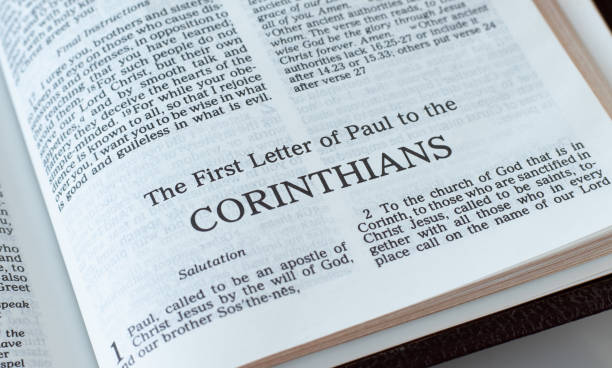
The following includes a captivating Scriptural account of original New Covenant meetings and the Apostle Paul’s detailed Scriptural instructions thereof.
.
1 CORINTHIANS 14
As a lead in to what we will be looking into regarding how the Early Church originals in the first century AD actually conducted their spiritual meetings, I will present here the entire fourteenth chapter of the Apostle Paul’s first letter to the believers in the Greek city of Corinth. This chapter is probably not only the most representative of the content of Christian meetings but also gives the most amount of information with regard to what took place in them. In Chapter 12 Paul had just addressed the many spiritual gifts, manifestations of the Spirit, and places of service in the Community and touches on them again in Chapter 14, applying instructions on their use.
If you have yet to read Part 1 I highly recommend it since it sets the tone for the series. There are already many edifying comments there which add to the article content and I am most appreciative of those of you who participated. Thank you.
I also decided to add the Scriptural text as it appears in the NASB95 online version which includes full footnotes. Though I have used and still use many different Bible versions I began using the New American Standard Bible 1995 Update exclusively for teaching and writing purposes about the time it was first published. To clarify the text format I have added the following explanations per the Bible’s introduction:
- FOOTNOTES are used only where the text especially requires them for clarification.
- ITALICS are used in the text to indicate words which are not found in the original Hebrew, Aramaic, or Greek but implied by it.
- SMALL CAPS in the New Testament are used in the text to indicate Old Testament quotations or obvious references to Old Testament texts.
Now let’s read what Paul wrote way back when and see how the meetings of our original forebears proceeded:
1 Pursue love, yet desire earnestly spiritual gifts, but especially that you may prophesy. 2 For one who speaks in a tongue does not speak to men but to God; for no one [a]understands, but [b]in his spirit he speaks mysteries. 3 But one who prophesies speaks to men for edification and exhortation and consolation. 4 One who speaks in a tongue edifies himself; but one who prophesies edifies the church. 5 Now I wish that you all spoke in tongues, but even more that you would prophesy; and greater is one who prophesies than one who speaks in tongues, unless he interprets, so that the church may receive edifying.
6 But now, brethren, if I come to you speaking in tongues, what will I profit you unless I speak to you either by way of revelation or of knowledge or of prophecy or of teaching? 7 Yet even lifeless things, either flute or harp, in producing a sound, if they do not produce a distinction in the tones, how will it be known what is played on the flute or on the harp? 8 For if the [c]bugle produces an indistinct sound, who will prepare himself for battle? 9 So also you, unless you utter by the tongue speech that is clear, how will it be known what is spoken? For you will be speaking into the air. 10 There are, perhaps, a great many kinds of [d]languages in the world, and no kind is without meaning. 11 If then I do not know the meaning of the language, I will be to the one who speaks a [e]barbarian, and the one who speaks will be a [f]barbarian [g]to me. 12 So also you, since you are zealous of [h]spiritual gifts, seek to abound for the edification of the church.
13 Therefore let one who speaks in a tongue pray that he may interpret. 14 For if I pray in a tongue, my spirit prays, but my mind is unfruitful. 15 What is the outcome then? I will pray with the spirit and I will pray with the mind also; I will sing with the spirit and I will sing with the mind also. 16 Otherwise if you bless [i]in the spirit only, how will the one who fills the place of the [j]ungifted say the “Amen” at your giving of thanks, since he does not know what you are saying? 17 For you are giving thanks well enough, but the other person is not edified. 18 I thank God, I speak in tongues more than you all; 19 however, in the church I desire to speak five words with my mind so that I may instruct others also, rather than ten thousand words in a tongue.
20 Brethren, do not be children in your thinking; yet in evil be infants, but in your thinking be mature. 21 In the Law it is written, “BY MEN OF STRANGE TONGUES AND BY THE LIPS OF STRANGERS I WILL SPEAK TO THIS PEOPLE, AND EVEN SO THEY WILL NOT LISTEN TO ME,” says the Lord. 22 So then tongues are for a sign, not to those who believe but to unbelievers; but prophecy is for a sign, not to unbelievers but to those who believe. 23 Therefore if the whole church assembles together and all speak in tongues, and [k]ungifted men or unbelievers enter, will they not say that you are mad? 24 But if all prophesy, and an unbeliever or an [l]ungifted man enters, he is convicted by all, he is called to account by all; 25 the secrets of his heart are disclosed; and so he will fall on his face and worship God, declaring that God is certainly among you.
26 What is the outcome then, brethren? When you assemble, each one has a psalm, has a teaching, has a revelation, has a tongue, has an interpretation. Let all things be done for edification. 27 If anyone speaks in a tongue, it should be by two or at the most three, and each in turn, and one must interpret; 28 but if there is no interpreter, he must keep silent in the church; and let him speak to himself and to God. 29 Let two or three prophets speak, and let the others pass judgment. 30 But if a revelation is made to another who is seated, the first one must keep silent. 31 For you can all prophesy one by one, so that all may learn and all may be exhorted; 32 and the spirits of prophets are subject to prophets; 33 for God is not a God of confusion but of [m]peace, as in all the churches of the saints.
34 The women are to keep silent in the churches; for they are not permitted to speak, but are to subject themselves, just as the Law also says. 35 If they desire to learn anything, let them ask their own husbands at home; for it is [n]improper for a woman to speak in church. 36 [o]Was it from you that the word of God first went forth? Or has it come to you only?
37 If anyone thinks he is a prophet or spiritual, let him recognize that the things which I write to you are the Lord’s commandment. 38 But if anyone does not recognize this, he [p]is not recognized.
39Therefore, my brethren, desire earnestly to prophesy, and do not forbid to speak in tongues. 40But all things must be done properly and in an orderly manner. [1Corinthians 14:1-40] [1]
FOOTNOTES:
a. Lit hears
b. Or by the Spirit
c. Lit trumpet
d. Lit voices
e. Or foreigner
f. Or foreigner
g. Or in my estimation
h. Lit spirits
i. Or with the
j. I.e. unversed in spiritual gifts
k. V 16, note 2
l. V 16, note 2
m. Or peace. As in all…saints, let
n. Or disgraceful
o. Lit Or was
p. Two early mss read is not to be recognized
© 2025 by RJ Dawson. All Rights Reserved. [To Be Continued…]
[1] Unless otherwise noted all Scriptures are taken from the New American Standard Bible, © 1960, 1963, 1968, 1971, 1972, 1973, 1975, 1977, 1995 by The Lockman Foundation. Used by permission.


 Real Christianity